From the workbench
Why Do Prewar Gibson Banjo Flanges Warp or Pull Up?
The one-piece flange helped define the classic Gibson Mastertone—but the earliest zinc-alloy castings came with weaknesses that still matter today.
The short answer
Prewar Gibson banjo flanges will often warp or pull upward after decades under the steady load of the head, hooks, rim, and tension hoop. The earliest one-piece flanges were also made during a period of rapid development, and some of those zinc-alloy castings have proven more fragile than others. That does not mean every original flange is failing, but age, fit, head tension, casting quality, and earlier adjustments can all affect its condition today.
When an early one-piece-flange Gibson comes to my bench, I examine the flange closely before I try to loosen or adjust anything. From the outside it may look perfectly fine. Beneath the tension hoop and around the rim, however, it may already be pulling upward, locking hooks in place, cracking near an opening, or pressing unevenly against the wood. On a banjo approaching a century old, those changes are more than cosmetic. They help determine what can be adjusted safely—and sometimes whether the head can be removed without risking the original hardware.
The one-piece flange arrived during a period of rapid change
Gibson began using the die-cast one-piece flange on production banjos in 1929, although tube-and-plate construction continued on some instruments into the early 1930s. The new casting became an important part of the classic Mastertone pot and allowed the flange and bracket-shoe function to be combined into one piece.
The original Doehler production drawing for the Gibson flange is dated November 15, 1928. By July 26, 1929, several engineering changes had already made that first version obsolete and led to a second-generation part. More revisions followed. In other words, the familiar prewar one-piece flange was not one unchanging part made exactly the same way throughout the period.
“Pot metal” does not mean one exact formula
Players often describe these flanges as pot metal, but that is a broad name rather than a precise recipe. The castings were made from a zinc-based die-casting alloy. Their strength and long-term stability depended on the purity and proportions of the metals, how completely the alloy filled the die, how it cooled, whether porosity or other flaws were left inside the casting, and the thickness and shape of the finished part.
That is why it is more accurate to talk about the complete casting process and flange design than to blame one known “bad formula.” The surviving evidence tells us the early parts were revised. It does not give us a simple factory note saying that one alloy change solved everything on a particular date.
Why do early one-piece Gibson flanges warp, pull up, or crack?
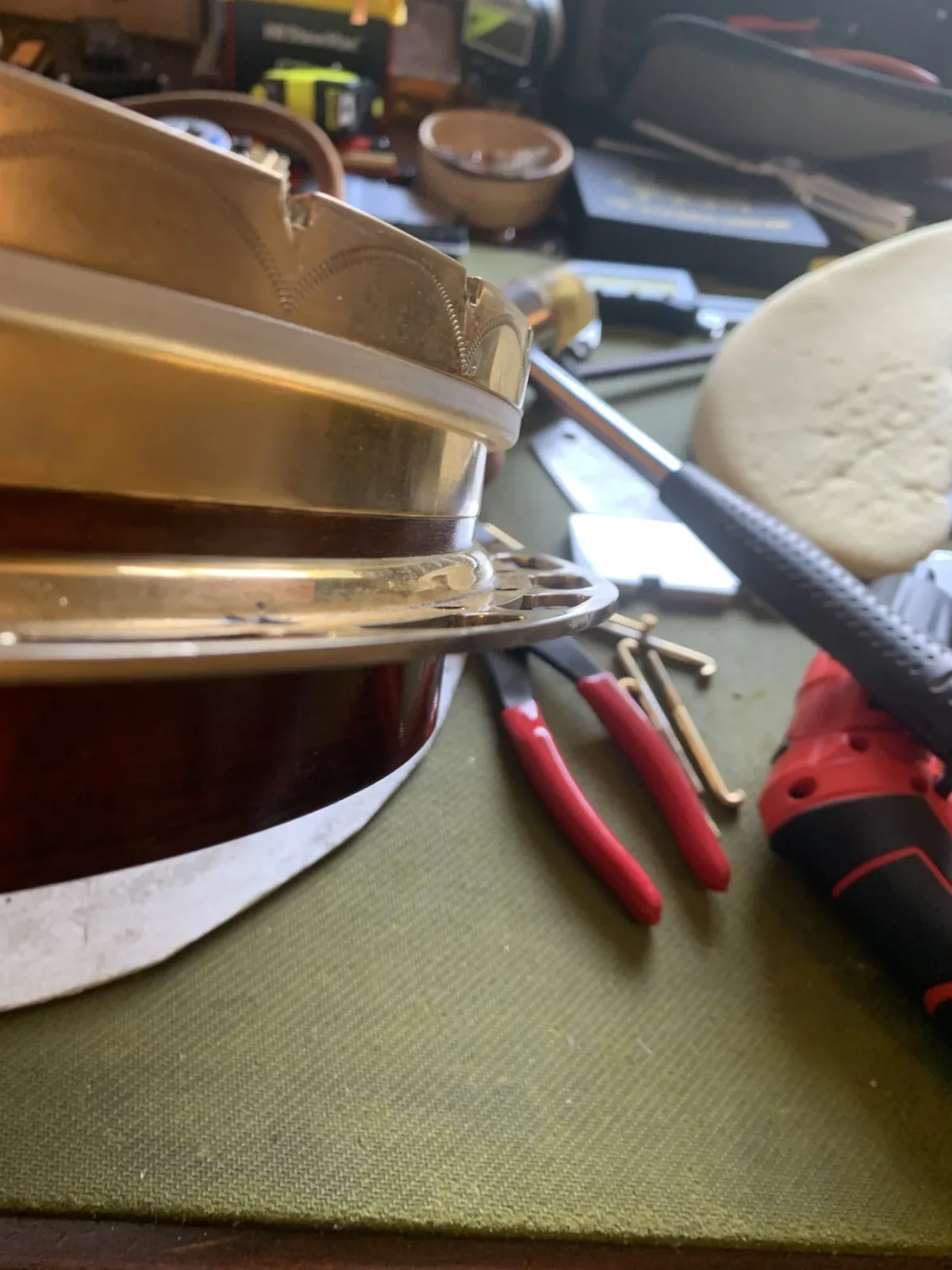
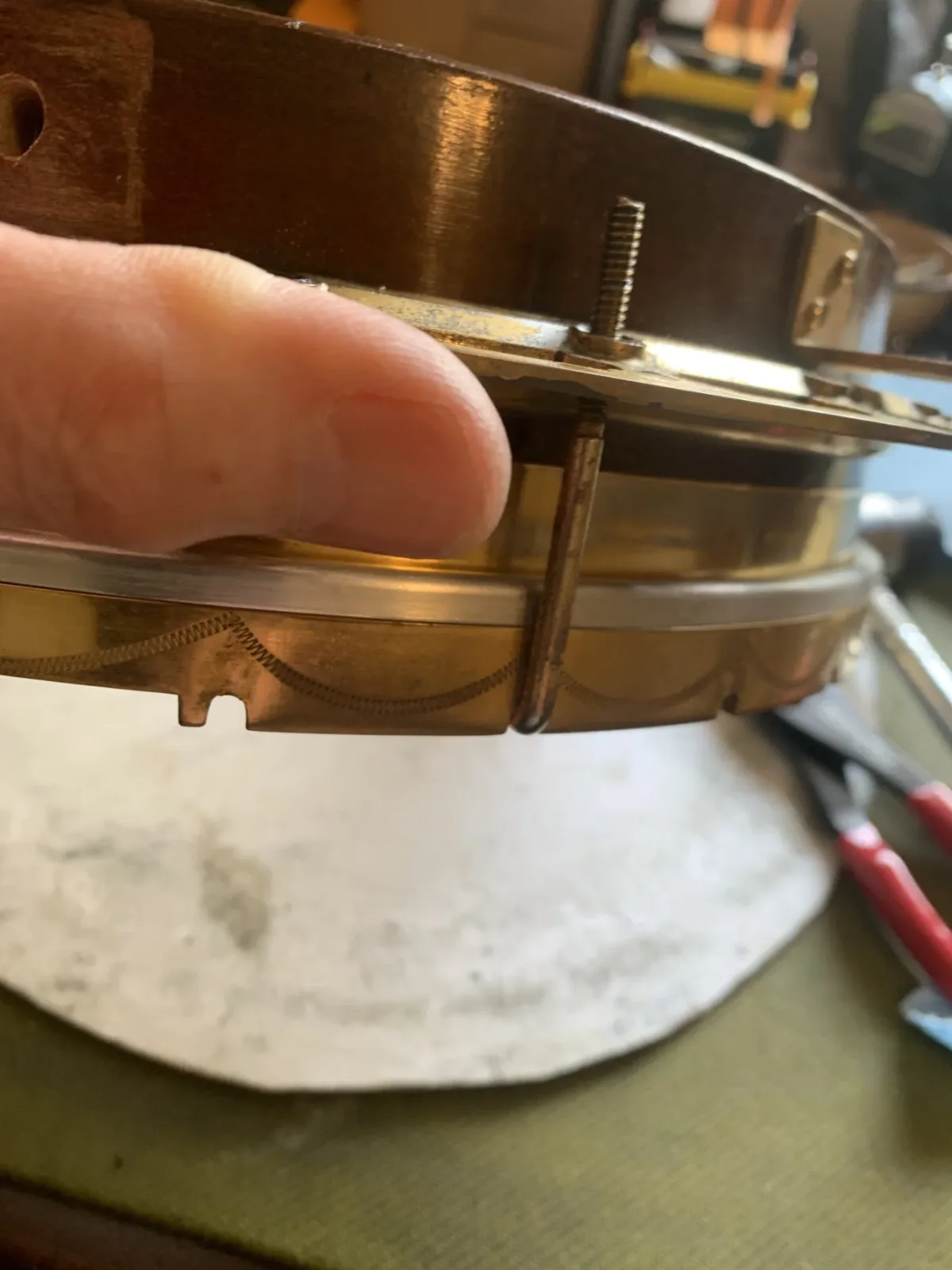
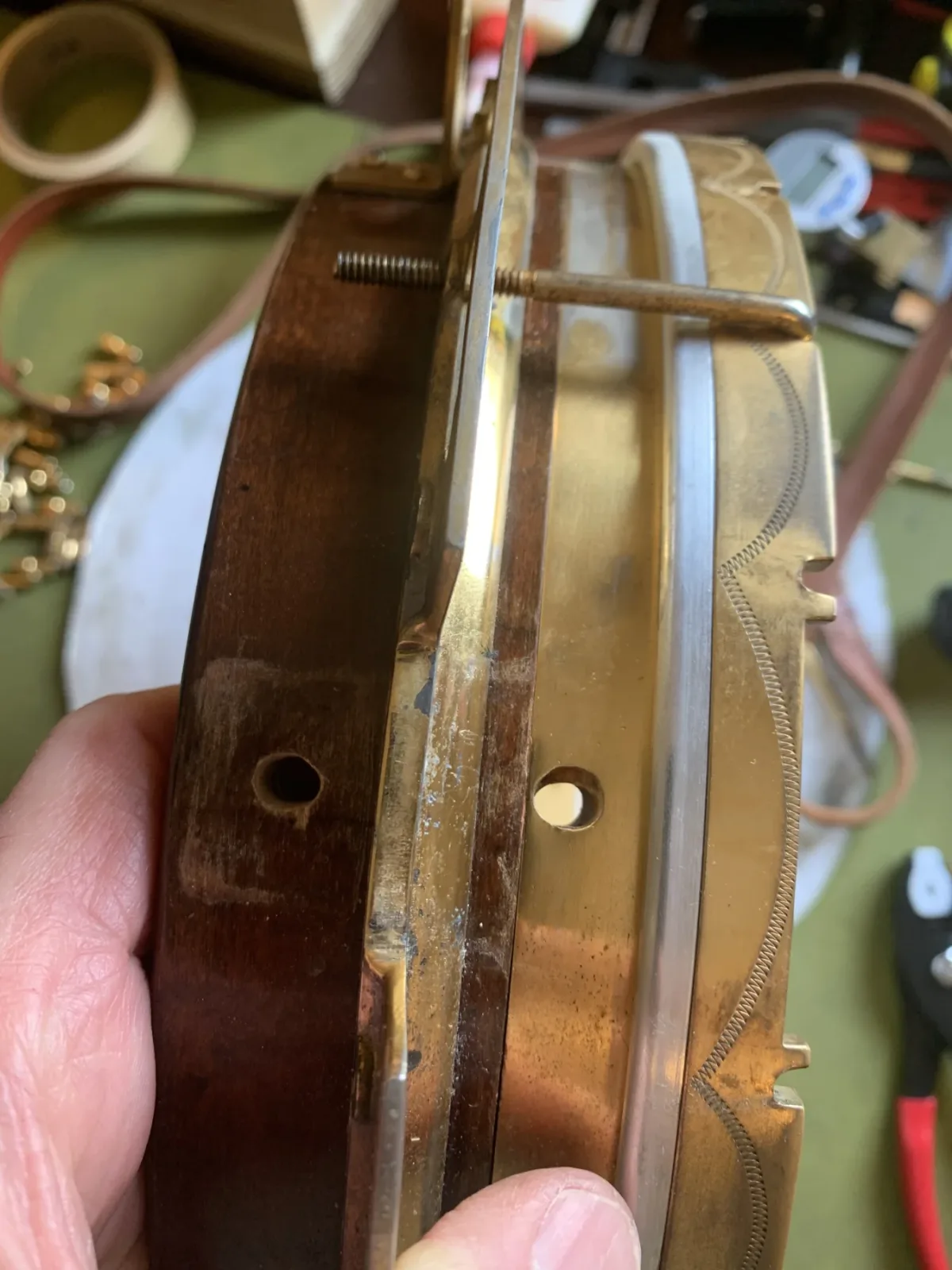
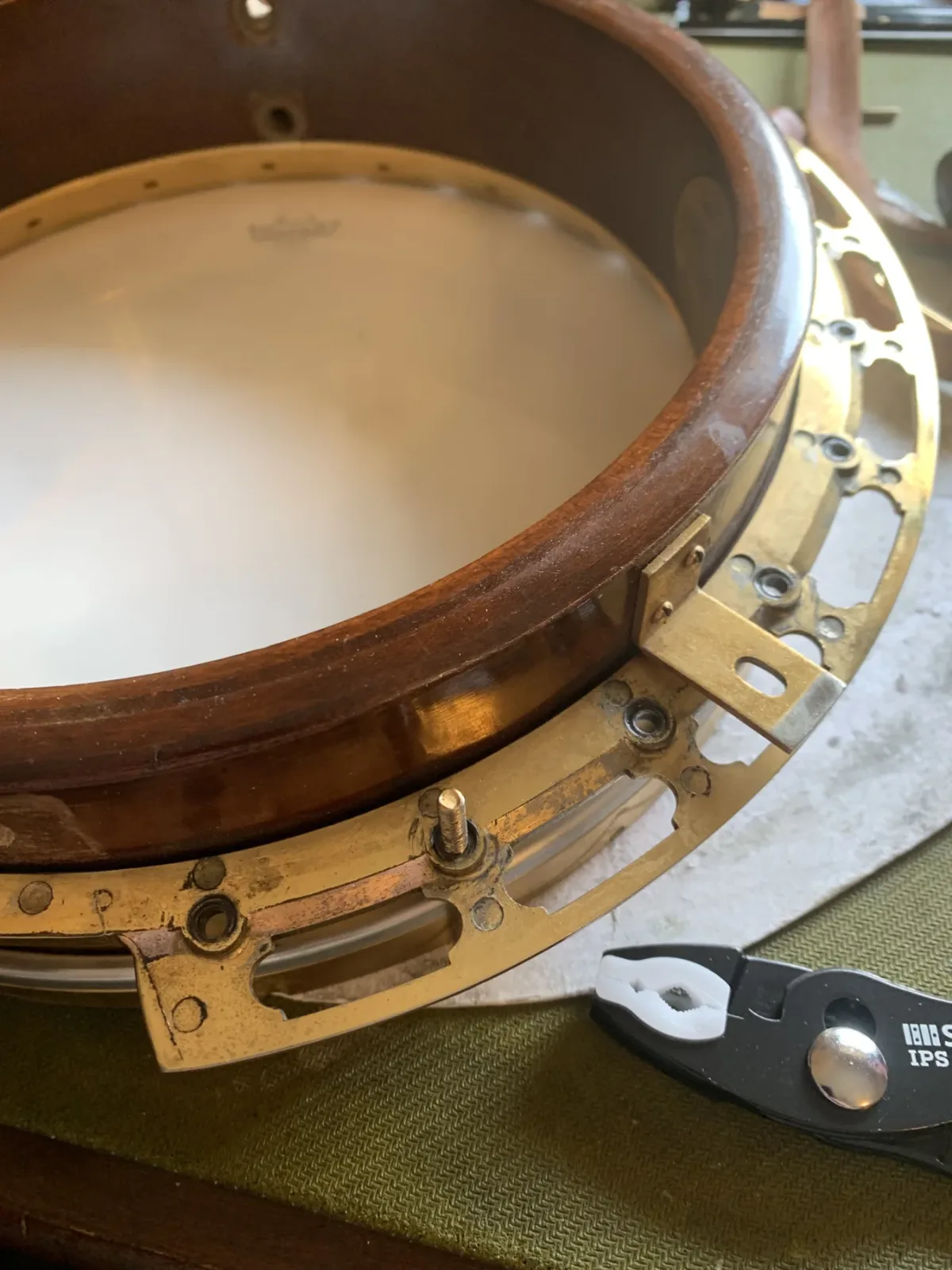
A one-piece flange lives under steady mechanical load. The tension hooks pull against it, the wooden rim supports it, and the head tension above it adds to the system. Year after year, a vulnerable casting can slowly pull upward around the rim. Openings may distort, hooks can become trapped, and cracks may begin near thin or highly stressed areas.
Excessive tightening, forcing a stuck hook, or rough handling can certainly make the damage worse. But I would not assume that a warped original flange proves someone abused the banjo. A fragile early casting may continue to move gradually even when the instrument has been treated with care.
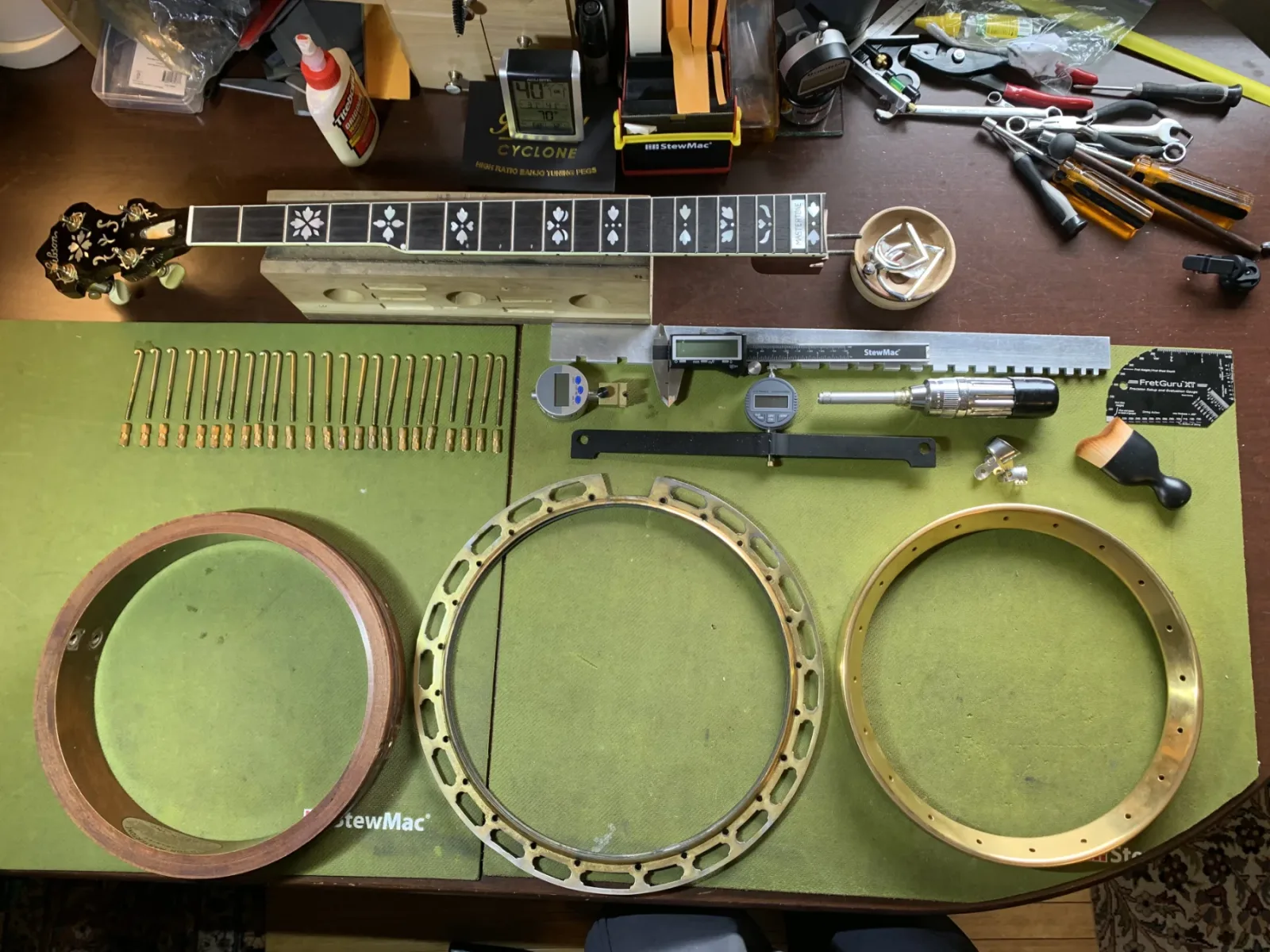
The photographs below show the original flange on Bill Evans’ 1929 “Sonny Osborne” Gibson Granada. Click any image for a closer look, then move through the photographs to see how the distortion changed the relationship among the flange, rim, hooks, and tension hoop.
 View larger image
 View larger image
 View larger image
 View larger image
 View larger image
How this original flange was returned to service
There is no way to “un-warp” an original flange like this and return it to its factory shape. Trying to force a fragile, nearly century-old zinc-alloy casting flat could crack or break it, while replacing it would remove an important part of the Granada’s history and value. Bill chose to preserve the original, so I completely disassembled the pot, carefully removed the flange, and inspected it for stress cracks and other damage. Every bracket and nut was cleaned and lubricated, then returned to its original location.
I micro-adjusted each bracket individually to match the flange’s unique warping at its original location around the rim and tension hoop. It was slow, delicate work, but it restored enough safe movement to install a new head, bring the tension up evenly, and balance and tune the tone chamber. A light fret dressing, along with careful nut and fifth-string-pip work, completed the setup.
The result was not simply a banjo that could be adjusted again. Its rich tone, power, clarity, sustain, dependable tuning, and comfortable response returned—bringing this remarkable Granada back to the professional playing and recording standard Bill depends on.
Later revisions helped, but there is no clean cutoff date
Later flange patterns were revised and are often more robust, but there is no dependable calendar date when every earlier weakness suddenly disappeared. Gibson used parts from existing inventory, and early and later flange designs can overlap across factory-order groups. An older flange can also have been replaced sometime during the banjo’s long life.
For that reason, the date or factory order number is useful history, but it cannot tell the whole story. I look at the particular flange in front of me: its shape, generation, fit on the rim, relationship to the tension hoop and hooks, and the condition of the casting today.
What are the signs of a warped banjo flange?
A flange that is beginning to fail may pull upward unevenly, sit at a different height around the rim, distort the hook openings, or develop a crack near an opening or edge. Hooks may no longer move freely. The tension hoop may become difficult to lower evenly, the resonator fit may change, or the head may be impossible to remove without first dealing with trapped hardware.
Changes in head tension can also affect tuning stability, clarity, response, and power, but those sound and playing symptoms are not proof that the flange is at fault. They are reasons to inspect the whole pot assembly carefully. If the hardware is bound or badly distorted, forcing it usually creates a larger and more expensive problem.
What I look for before I turn a wrench
Before I try to loosen or tension anything, I look at the flange from several angles, compare its height around the rim, inspect the thin areas around the openings, and see whether the hooks can actually move. I also check the rim-to-flange fit, tension-hoop position, head condition, coordinator hardware, and any evidence of earlier repair.
This is one of those places where patience matters. The goal is not simply to make an old part move. It is to understand why it is stuck, protect the rim and surrounding hardware, and choose the least invasive path that will return the banjo to safe, dependable playing condition.
Can a warped prewar Gibson flange be repaired?
An original flange is part of the history and value of a prewar Gibson, so I preserve it whenever that can be done safely and responsibly. Sometimes careful disassembly, fitting, and adjustment can stabilize the original hardware and allow it to keep doing its job. In other cases, a severely cracked or distorted flange may no longer be trustworthy under full tension, and a well-fitted replacement may be the safest playing solution.
There is no single answer for every old Gibson. The right decision depends on the condition of the casting, the originality and value of the instrument, how the banjo will be used, and what matters most to its owner. My job is to explain what I find clearly, protect as much original material as possible, and help the owner make an informed choice.