From the workbench
How Does the Banjo Head Affect Tone?
The head is one of the biggest voices in the whole banjo.
The short answer
The banjo head does much more than cover the pot. It is the instrument’s main soundboard, receiving the strings’ energy through the bridge and turning it into much of the sound and response we recognize as a banjo. The type of head, its coating, fit, condition, and working tension can all change what the player hears and feels. Choosing a replacement is therefore not simply a matter of ordering the right diameter. The head needs to fit the banjo safely and help that particular instrument produce the sound its player is looking for.
Not every banjo head sounds or feels the same
A traditional top-frosted head is a familiar starting point on a five-string resonator banjo. Its light film and textured surface often give a quick attack, crisp note separation, good snap, and controlled sustain—qualities many bluegrass players enjoy when the notes need to stay clear at speed.
Even heads that look similar can behave differently. Manufacturers use different coating formulas, textures, coverage, and coating weights. In my experience, a heavier coating, such as the coating found on some Stelling- and AMB-style heads, can soften a little upper-frequency edge, control unwanted overtones, and add body. A more lightly coated standard Remo may feel quicker, brighter, and more immediate. These are useful tendencies, not guarantees, which is why I listen to the actual banjo rather than choosing by the label alone.
Renaissance, Fiberskyn, clear, bottom-coated, and natural-skin heads move the sound in other directions. A Renaissance head is often warmer and more sustaining than a conventional top-frosted head while keeping more brightness than Fiberskyn. Fiberskyn and natural skin generally lean toward a rounder, warmer, more old-time voice. The bridge, rim, tone ring or hoop, tailpiece, strings, tension, and player still shape the final result, so no head works in isolation.
The music gives us direction, but the player makes the final choice
An old-time or clawhammer player may want warmth, depth, a softer attack, and a controlled plunk. A bluegrass player may want a faster response, strong projection, clean note separation, and enough presence to carry through an acoustic band. Those preferences help narrow the choices, but they do not create hard rules. Some bluegrass players want additional warmth and sustain, while some old-time players prefer a brighter and more immediate response.
The better question is not, “Which head is best?” It is, “What do you want this banjo to do?” I listen to the player’s touch, right-hand position, preferred balance of bass and treble, need for sustain and projection, and the sound they have in mind. The head then becomes part of a complete tonal plan built around that player and that banjo—not an isolated upgrade chosen from a catalog.
Crown height is about fitting the banjo correctly and safely
Crown height is measured from the top of the head’s mounting band to the playing surface. Synthetic heads are commonly offered in low, medium, and high crowns—roughly 3/8, 7/16, and 1/2 inch. These are not bright, balanced, and warm versions of the same head. Crown height determines where the tension hoop will sit once the head reaches working tension.
Archtop, or raised-head, tone rings usually need a low-crown head, although some instruments are correctly fitted with a medium crown. Flathead tone rings and flat-topped banjos often use a medium- or high-crown head. That distinction is a helpful starting point, not a substitute for measuring the instrument and checking the manufacturer’s specifications. Vintage banjos can also have nonstandard dimensions, distorted hardware, or old parts that should never be forced to accommodate the wrong head.
If the crown is too low, the tension hoop may remain high enough to interfere with the strings, neck notch, tailpiece, or the player’s hand. If it is too high, the hoop may pull down too far or leave too little hook adjustment. The correct crown allows the head to seat evenly, reach the right tension safely, and preserve the intended relationship among the head, hoop, neck, and tailpiece.
An older head can be failing where you cannot see it
A synthetic head does not expire on a fixed date, but it does not stay unchanged forever. In my shop I often find that an older head has lost some resilience, response, or tension stability after many years of service. Eight to ten years can be a useful point to begin paying closer attention, but it is not an automatic replacement schedule. Playing time, tension, temperature and humidity changes, coating wear, storage, and the original installation all affect how a head ages.
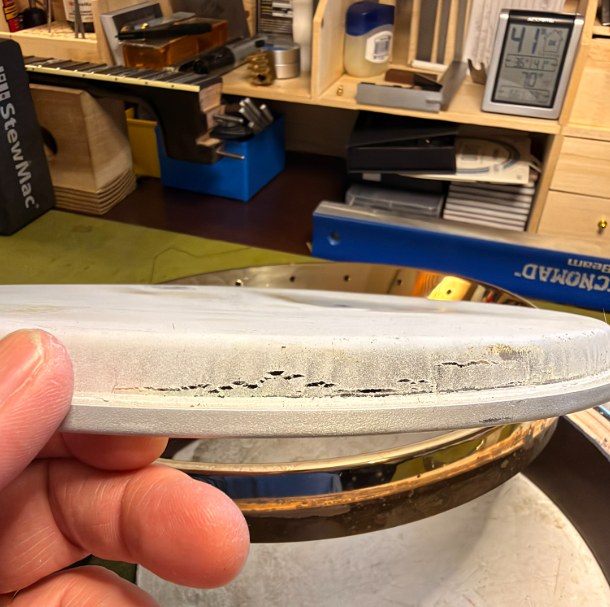
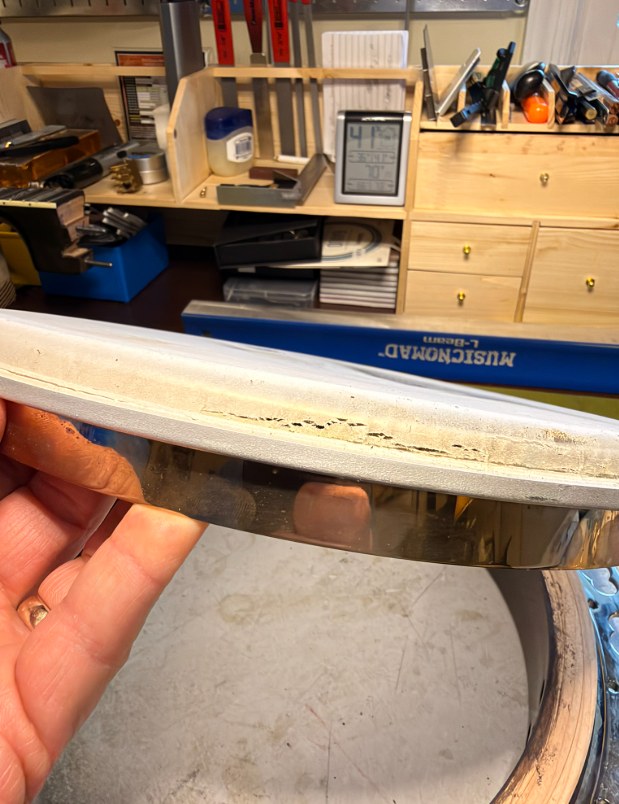
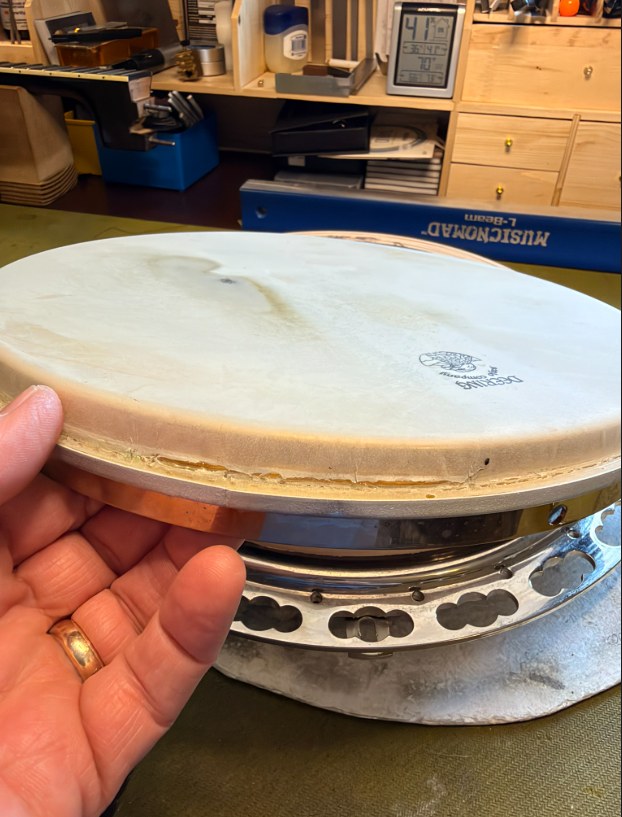
Some of the most important damage stays hidden while the banjo is assembled. Cracks, stretching, or separation can develop where the film meets the mounting band beneath the tension hoop. From above, the head may still look perfectly usable. The photographs below show what I found only after taking a banjo apart.
The clues often appear in the way the banjo behaves: tuning that will not settle, tension that will not remain even, weaker tone, less clarity or note separation, reduced sustain and projection, or a response that feels softer and less immediate. Those symptoms can come from other parts of the setup, so they do not prove the head is failing. They do tell us that an older, unstable head deserves a careful inspection.
 View larger image
 View larger image
 View larger image
Installing the head is only the beginning
A new head changes the support beneath the bridge, which can affect action, intonation, sustain, tailpiece relationship, and the balance of the complete pot assembly. It also stretches and settles during its first period of use, so the tension and setup normally need to be checked again.
The goal is not simply to replace one white membrane with another. It is to choose the right construction and crown, seat it evenly, bring it to a balanced working tension, and then listen to how the complete banjo responds. When the head, bridge, tailpiece, pot, neck, and player are working together, the instrument feels more open, stable, and alive.