From the workbench
How Neck Relief Affects Banjo Tone and Note Clarity
A little neck relief helps a banjo breathe. Too much can create problems of its own.
The short answer
When a banjo starts buzzing, it is tempting to reach for the truss-rod wrench and add more bow to the neck. I understand why—sometimes a small increase in relief is exactly what the banjo needs. But relief is only one part of the setup. If the real problem is a high or worn fret, an incorrectly cut nut slot, low action, or an unstable neck, adding more bow may simply move the buzz while making the banjo harder to play. The goal is not a magic number or the greatest possible clearance. It is a stable neck curve that lets the strings move freely and works with the frets, nut, action, bridge, and the player’s touch.
What the truss rod actually changes
The truss rod controls the lengthwise curve of the neck. It is not a general action adjustment, and it cannot correct every source of buzzing. Neck relief is the very gentle forward curve that remains when the strings are tuned to pitch. That small curve gives a vibrating string the room it needs between the fretted note and the bridge.
Because a truss-rod adjustment changes the relationship between the strings and many frets at once, even a small turn can alter the feel, attack, sustain, intonation, and location of a buzz. That is why I first want to know where and when the problem occurs before changing the rod.
More relief is not always the answer
If a neck is too straight or slightly back-bowed, the strings may not have enough room over the lower frets. In that case, a carefully measured increase in relief can help. But when the neck already has enough forward curve, adding more bow raises the strings through the middle and sends them “uphill” toward the higher frets. The action becomes less comfortable, notes are easier to pull sharp, and a new buzz may appear in the middle of the neck.
The location of a buzz gives us useful clues. An open-string buzz that disappears when the string is fretted points us toward the nut or another open-string endpoint. Buzzing in the first few frets may involve too little relief or an uneven fret. Trouble in the middle can suggest too much relief or irregular fret height, while buzzing high on the neck often directs attention toward action, neck angle, upper-fret geometry, or the bridge. These are clues rather than absolute rules, because several small issues can overlap.
Good fretwork and nut work come first
A banjo can have a powerful, clear voice with a fairly straight neck when the frets form a smooth, consistent playing surface and the nut is fitted and cut correctly. The frets must be seated securely, level with one another, and properly crowned. The nut must fit its seat, and every slot needs the right height, width, shape, and break angle for its string.
A high fret, a worn-low fret, or an incorrect nut slot can sometimes be hidden temporarily by adding more relief, but the underlying problem is still there. One area may play more cleanly while the action rises, intonation suffers, response weakens, or a new buzz appears somewhere else. When the nut and frets are right, relief can be chosen to suit the banjo and the player instead of being used to compensate for another problem.
A simple check you can make at home
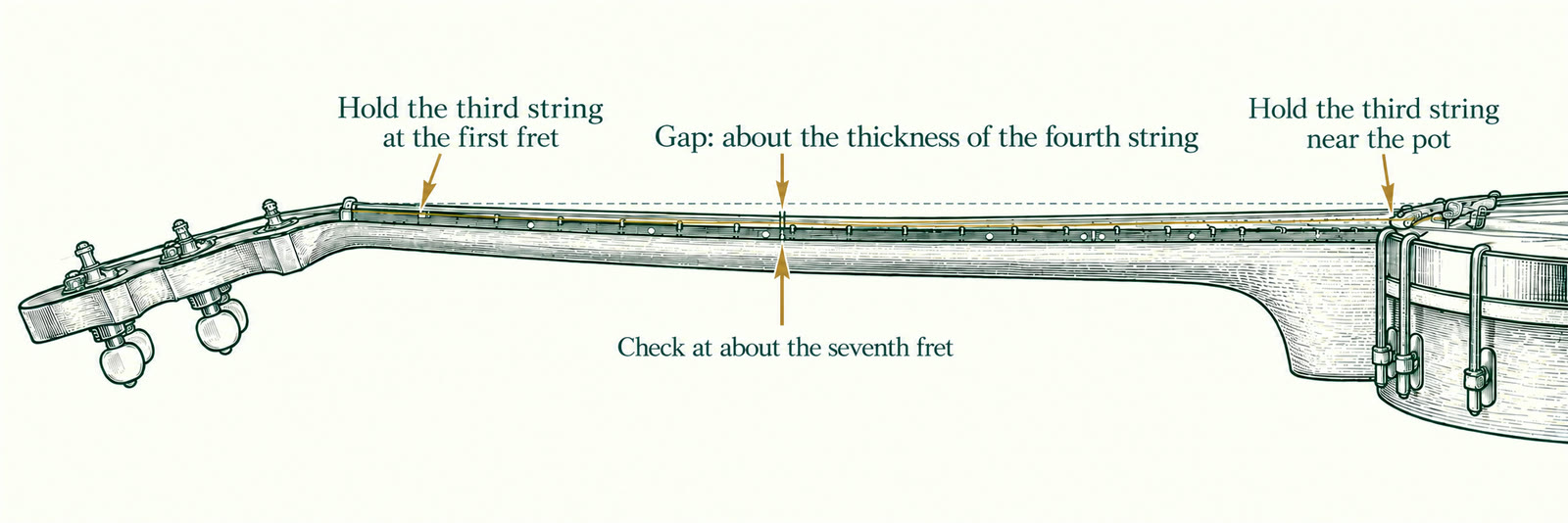
Most players do not have precision neck-measuring tools, but the third string can give you a useful visual reference. With the banjo tuned to pitch, hold the third string down at the first fret and again at the last fret near the pot. The string now acts as a temporary straightedge. Look at the small gap between the string and the top of the seventh fret.
For this shop check, I often compare that gap with the thickness of the banjo’s installed fourth string. It is a rough visual reference, not a universal specification. If the third string is very close to—or touching—the seventh fret, the neck may need a little more relief. If the gap is noticeably larger than the fourth-string reference, it may need less.
This is meant to help you understand what you are seeing, not send you immediately for a wrench. Different banjos, string gauges, fretwork, bridge heights, actions, playing styles, and picking techniques can require different final clearances. The manufacturer’s guidance or the measurement in a Personal Setup Profile is the better reference when one is available.
 View larger image
Relief changes more than playing height
Relief is usually discussed as a playability measurement, but you can hear it as well as feel it. With the right clearance, a note can ring cleanly without repeatedly touching the next fret. The attack stays clear, more of the string’s energy reaches the banjo, and the instrument can respond to a lighter touch while still handling the player’s normal picking strength.
Too little clearance may create an obvious metallic buzz, but it can also quietly reduce note body and sustain before you hear a distinct rattle. Too much relief can make the banjo feel slow or resistant, change the response from one area of the neck to another, and require extra fretting pressure that pulls notes sharp. The right neck curve helps the banjo feel even, clear, and predictable up and down the fretboard.
Look at the whole banjo before turning the rod
A useful evaluation begins with fresh strings, the banjo tuned to pitch, and the instrument held in a normal playing position. I note exactly where the buzz occurs—by string and fret—and whether it changes when the string is open, fretted, or capoed. The nut slots, fret condition, neck stability, relief, action, neck angle, bridge, head tension, and loose hardware can then be considered in a sensible order.
A neck that keeps changing after an adjustment deserves a closer look. Repeatedly turning the truss rod to chase a moving measurement can hide an unstable neck, binding or slack in the adjustment system, environmental movement, or another mechanical problem. Any truss-rod adjustment should be small and deliberate because excessive force can damage the rod or neck. The goal is not to silence a buzz for a few minutes. It is to establish a stable relationship among the nut, frets, neck, action, and player so the banjo stays clear, comfortable, and dependable.