From the workbench
How Gibson’s Prewar Banjo Flanges Evolved
From separate shoes and resonator plates to the one-piece flange that helped define the classic Mastertone, Gibson’s banjo pot changed quickly—and the transition did not always go smoothly.
The short answer
The flange may look like a decorative band around the outside of a resonator banjo, which it is, but it is also a critical part of the working structure of the pot. It helps support the tensioning hardware, provides the opening between the rim and resonator, and—together with the rim, hoop or tone ring, head, and resonator—forms part of the system that gives the banjo its responsiveness and unique voice.
Gibson entered the banjo market in 1918 and spent the next two decades revising nearly every part of the instrument. The familiar prewar Mastertone pot was not one sudden invention. It evolved through a sequence of rim, resonator, tone-chamber, neck-attachment, hook, tension-hoop, and flange changes.
Gibson did not move from one design to another in a few months. Parts overlapped, older construction remained on some models, rims were adapted, and instruments could move through assembly at different speeds. That is why the history is fascinating—and why a date or factory order number (FON) alone cannot tell us everything about the hardware on a particular prewar Gibson banjo.
Before the familiar Mastertone pot
Gibson’s first announced banjo in 1918 was a tenor model, followed by a broader family of tenor, guitar, mandolin, and cello banjos. These earliest instruments did not yet have the heavy cast tone ring or full-resonator pot that players now associate with a Mastertone. Gibson experimented with hollow and double-wall rims, bracket bands, individual shoes, simple tone hoops, and removable backs or “Tone Projectors.”
A 1922 Gibson patent covered an early rim and neck-attachment system, showing that the company was already treating the neck, rim, and hardware as one connected structure. Early resonator banjos could use individual bracket shoes fastened through the wooden rim, with a separate plate or other hardware below them. Those parts performed jobs that would later be combined or reorganized in the classic Mastertone pot.
The important point is that there was no single “prewar Gibson flange” from the beginning. Gibson’s line was developing during the height of the Jazz Age, when tenor and plectrum banjos were in strong demand. Different constructions appeared across price levels and models, and a lower-priced banjo could retain shoes or a stamped plate while a Mastertone used a very different assembly.
1925: the full-resonator Mastertone takes shape
Gibson announced its full-resonator, spring-loaded ball-bearing tone chamber in February 1925. The Mastertone name appeared as a style designation in a July price list, and the first Granada was announced that year. These instruments helped establish the basic full-resonator form that would become central to Gibson’s professional banjos.
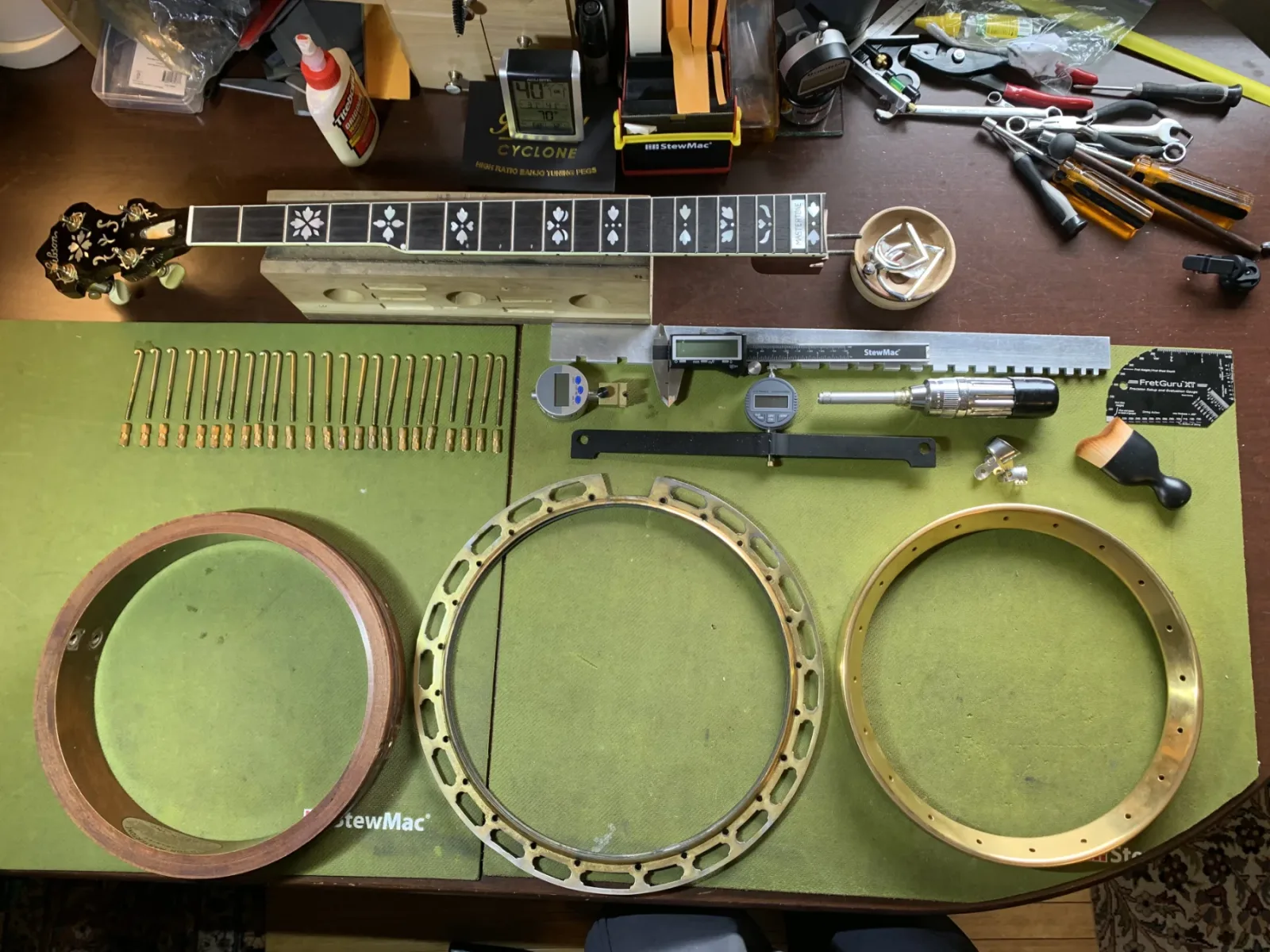
The pot used a hollow metal tube around the rim with a separate perforated plate below it—the construction players now call a tube-and-plate, two-piece flange, or TPF. The bracket hooks sat in the notches of the tension hoop and extended downward through aligned openings in the hollow tube and flange plate, where bracket nuts secured them from below. Tightening those nuts pulled the tension hoop down to tension the head. The tube, supported by the turned wooden bead on the rim, distributed that load around the pot, while the separate perforated plate filled the space between the rim and resonator and provided openings for sound. Together they formed the two-piece flange assembly, with the tube serving as the principal structural support for the hooks.
The Granada, Style 3, Style 4, and Style 5 were among the models that helped establish this full-resonator Mastertone family. The construction is not simply an outdated version of the later pot; it uses a different rim profile and distributes stress differently.
1927 and 1928: new tone rings, new models, continued experimentation
By 1927, Gibson had moved beyond the complicated ball-bearing assembly on many Mastertones and was using a cast raised-head tone ring. The cast ring, notched tension hoop, round hooks, and four-ply rim with a machined lip for the tube simplified production while preserving the tube-and-plate system.
Jason Hathcock’s 1928 Gibson Granada offers a clear surviving example of this mature construction, including the full-thickness rim, hollow tube, separate perforated plate, and bracket-hook path that tie the assembly together. The elaborate Bella Voce and Florentine appeared in 1927, and Style 6 followed in 1928. Gibson also received its patent for the spring-loaded ball-bearing design in July 1928—after newer construction was already appearing. That timing is a useful reminder that patent dates, catalog announcements, factory use, and surviving instruments do not always line up in one simple sequence.
Tube-and-plate construction remained important, especially on higher-grade instruments, even while Gibson prepared the next major change. A late-1920s Gibson can therefore be historically correct with a two-piece flange, and an ornate model is not automatically supposed to have the one-piece flange that bluegrass players later came to prize. Model, factory order, construction details, and evidence of later modification all have to be considered together.
1929: the one-piece flange arrives
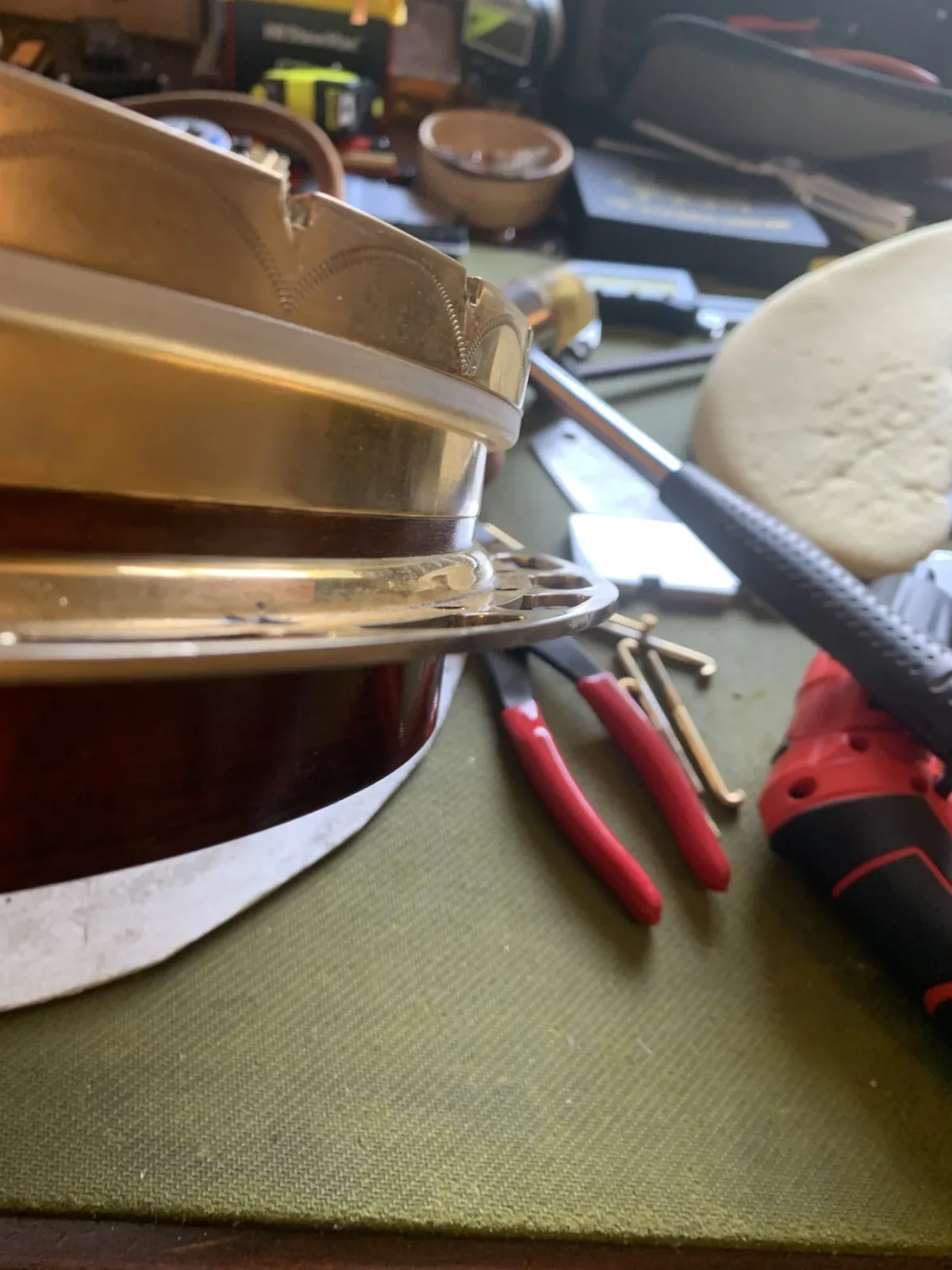
The die-cast one-piece flange entered Gibson production in 1929. Instead of using a separate tube and plate, the new casting combined the hook-bearing ledge and resonator flange into one zinc-alloy part. It was paired with a three-ply rim cut specifically so the flange could slide over the lower rim. Compared with the full-thickness tube-and-plate rim, this left a thinner wooden skirt below the tone ring and eliminated the lip that had supported the tube.
Visible glue lines are not always a reliable ply count: thin filler strips used to close imperfect joints can make a three-ply rim appear to contain additional laminations, an identification caution described in Roger Siminoff’s Gibson construction notes. The new arrangement also reduced the number of separate parts and simplified manufacturing.
Gibson announced the one-piece flange, low-profile flathead tone chamber, and double-cut peghead in the same period. Those features did not appear on every instrument together, but their development became central to the prewar Gibson banjos that later shaped bluegrass sound and construction.
Published research on the surviving Doehler Die Casting Company production drawing dates the original one-piece-flange blueprint to November 15, 1928. Machining and early engineering work followed, and the first production generation appeared in early 1929. This is the clearest starting point for the familiar Gibson one-piece flange—but it was not the end of the design process.
 View larger image
The first design was revised within months
By July 26, 1929, several engineering changes had already made the first production version obsolete, leading to what researchers describe as a second-generation flange by the final quarter of that year. Additional revisions followed, changing dimensions, fit, and the relationship among the flange, rim, hooks, and neck heel.
That rapid revision history tells us two useful things. First, Gibson and its supplier were actively improving a new die-cast part rather than making one unchanging flange throughout the prewar period. Second, there is no honest basis for claiming that every weakness disappeared on one exact date.
Factory inventories overlapped, some earlier rims were adapted during development, and instruments were not always assembled or shipped in strict factory-order-number sequence.
The overlap also continued after the one-piece flange appeared. Roger Siminoff’s documented examples include 1930 Style 2 banjos that retained individual bracket shoes, a stamped flange with diamond-shaped openings, and a full-thickness rim—clear evidence that older construction remained in use after the newer flange entered production.
Which years deserve the closest attention?
The earliest 1929 one-piece flanges deserve especially careful inspection. Some of those first-generation zinc-alloy castings are now known for pulling upward, distorting around the hook openings, cracking, or breaking after decades under load. Gibson’s revisions later in 1929 addressed the original design, and later prewar patterns are often more robust, but “later” does not mean immune. Casting quality, rim fit, head tension, handling, prior repairs, and nearly a century of steady stress all affect the condition we see today.
A practical summary is that early 1929 is the clearest high-risk period, late 1929 marks meaningful design improvement, and the 1930s brought more mature versions rather than a single documented moment when the problem was permanently solved. The particular casting in front of us matters more than a simple cutoff year.
 View larger image